
Submerged Hollow Fiber MBR Membrane Bioreactor Pack
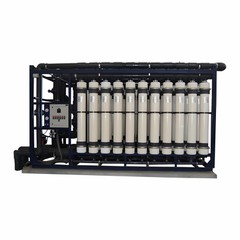
Submerged Hollow Fiber MBR Membrane Bioreactor Packs are engineered solid-liquid separation modules designed for advanced MBR wastewater treatment systems. Operating directly within activated sludge tanks, the module separates high-quality treated effluent while biological treatment continues uninterrupted.
Technical Specifications Overview
Note: Specific values vary based on custom configuration. Always confirm requirements with our technical team prior to design finalization.
|
Parameter |
Standard Specification |
Options / Notes |
|
Product Type |
Hollow fiber MBR membrane pack |
Immersed / Submerged |
|
Filtration Mode |
Outside-in |
Optimized strain relief design |
|
Membrane Material |
PVDF (Polyvinylidene Fluoride) / PES |
Hydrophilic modified polymer |
|
Nominal Pore Size |
0.03 micron - 0.1 micron |
Ultrafiltration / Microfiltration level |
|
Effective Membrane Area |
Customized per configuration |
Scalable module dimensions |
|
Design Flux |
10 - 25 LMH (Project dependent) |
Based on wastewater matrix |
|
Operating TMP |
-10 to -40 kPa |
Continuous monitoring recommended |
|
Operating Temperature |
5 deg C - 40 deg C |
Material dependent |
|
Operating pH Range |
2 - 11 |
Extended range during CIP |
|
Cleaning pH Range |
1 - 12 (NaOCl, Citric Acid) |
Dependent on chemical resistance |
|
Quality & Compliance |
ISO 9001 Certified Production |
Materials compliant with international standards |
Membrane Material Selection: PVDF vs. PES
Selecting the correct polymer prevents chemical degradation, fiber breakage, and premature fouling.
|
Feature / Property |
PVDF (Polyvinylidene Fluoride) |
PES (Polyether Sulfone) |
|
Mechanical Strength |
Extremely High (High tensile strength & tensile limit) |
Moderate |
|
Chemical Tolerance |
Superior (Resistant to high NaOCl exposure) |
Moderate (Sensitive to strong oxidants) |
|
Fouling Resistance |
Excellent (Hydrophilic modified) |
Good (Naturally hydrophilic) |
|
Typical Application |
Industrial wastewater, heavy solids, municipal MBR |
Light municipal, low-viscosity applications |
|
Primary Advantage |
Long operational lifespan under harsh CIP |
High initial pure-water permeability |
Evaluating Project Compatibility: An Engineered Approach
Selecting an MBR module based solely on membrane area or unit price often leads to undersized blowers, rapid fouling, and operational failure. A comprehensive design must account for total hydraulic and operational variables.
Wastewater Matrix Evaluation
• Organic & Solid Loadings: High COD, BOD, TSS, and MLSS (typically 6,000 - 12,000 mg/L) directly dictate allowable design flux.
• Inhibitors: Free oil & grease (< 10 mg/L recommended), high salinity, and extreme temperatures require specialized pretreatment and chemical selection.
Operating Flux & TMP Dynamics
Operating flux (LMH) must reflect fouling potential rather than maximum clean-water throughput.
Controlling Transmembrane Pressure (TMP) prevents irreversible cake layer compaction on the hollow fibers.
Integrated Air Scouring Demand
Air scouring generates fluid turbulence and fiber movement to shed accumulated solids. Air demand must be balanced against available blower capacity and tank geometry to maintain hydrodynamic shear across every fiber.
Primary Applications
Municipal Wastewater Treatment: High-purity effluent meeting stringent local discharge or reclamation standards.
Industrial Wastewater: Textile, chemical, pharmaceutical, and landfill leachate treatment requiring high chemical resistance.
Food & Beverage Wastewater: High-organic, fat, and grease streams requiring optimized cleaning cycles and robust MLSS management.
Water Reuse & RO Pretreatment: MBR permeate acts as superior feed water for downstream Reverse Osmosis (RO) or Nanofiltration (NF) systems.
New Project Design vs. Retrofit / Replacement
Retrofit & Module Replacement (Aftermarket)
Replacing modules in an existing MBR system requires strict dimensional and hydraulic matching.
Critical Compatibility Checklist:
External module footprint and height clearances
Connection types (Permeate manifold, air scouring inlet)
Aeration grid layout and existing blower air supply
Existing permeate pump suction capacity (TMP limit)
CIP chemical compatibility with existing dosing systems
Quality Control & Manufacturing Standards
Every membrane module undergoes multi-stage quality assurance to ensure leak-free operation and structural integrity:
Fiber Formation: Automated spinning control ensures uniform inner/outer diameters, wall thickness, and precise pore distribution.
Fiber Integrity Inspection: Tensile testing and bubble-point integrity screening prior to potting.
Potting & Sealing: High-grade polyurethane/epoxy potting seals the permeate manifold completely from mixed liquor contamination.
Finished Module Testing: 100% of modules undergo pure-water flux testing, pressure decay integrity checks, and visual alignment inspection before dispatch.
RFQ Checklist: What to Provide for an Express Quote
To receive an accurate technical proposal and budget estimate, provide the following details:
Project Information
Application Type: New Installation / Replacement
Capacity: Average Flow (m3/day or GPD) & Peak Flow
Target Effluent Quality: Disinfection / Reuse / Standard Discharge
Wastewater Parameters
Influent Matrix: COD, BOD, TSS, MLSS, Oil & Grease, Temperature, pH range
Chemical Exposure: Presence of solvents, surfactants, or heavy metals
For Retrofit / Replacement Projects
Existing Equipment Details: Original manufacturer, model number, total installed area
Dimensional Constraints: Tank water depth, basin dimensions, lifting headroom
Site Files: Drawings (CAD/PDF), nameplate photos, and manifold photographs
FAQ
Q: What is the typical lifespan of a hollow fiber MBR membrane?
A: Under standard operating conditions, proper pre-treatment, and regular CIP (Clean-In-Place) protocols, high-quality PVDF MBR membranes typically offer an operational lifespan of 3 to 7 years depending on wastewater aggressiveness.
Q: Can your MBR packs directly replace modules from major international brands?
A: Yes. We supply custom drop-in replacement modules matched precisely to the dimensions, manifold connections, mounting brackets, and aeration layouts of standard industry modules.
Q: How do I know if my system requires physical or chemical cleaning?
A: Air scouring and relaxed filtration cycles handle continuous physical cleaning. When TMP increases beyond the design threshold (typically > 30 kPa) or flux drops significantly, maintenance washing or intensive chemical cleaning (CIP) with NaOCl or organic acids is required.
Q: Why is PVDF preferred over PES for industrial MBR applications?
A: PVDF offers significantly higher tensile strength and superior chemical tolerance against strong oxidizing agents like chlorine (NaOCl). This allows aggressive chemical cleaning routines needed for difficult industrial fouls without degrading the membrane fibers.
Q: What minimum pretreatment is required before feeding wastewater into the MBR tank?
A: A fine screen (typically 1.0 mm to 2.0 mm punch-hole screen) is strictly required upstream of the MBR tank to remove hair, fibers, and debris that could cause ragging or damage to the hollow fiber modules. Oil and grease levels should also be reduced below 10 mg/L.
Hot Tags: hollow fiber mbr membrane bioreactor pack, China hollow fiber mbr membrane bioreactor pack manufacturers, suppliers, factory, Scalable Modular Wastewater System