

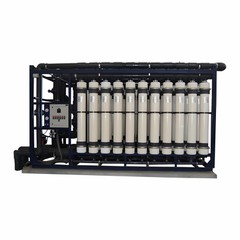

By integrating the flotation tank, micro-bubble air saturation system, automatic surface sludge scraper, sludge hopper, and PLC control system into a single skid-mounted package, this unit delivers reliable clarification prior to discharge or downstream biological treatment.
Typical Removal Efficiencies
|
Parameter |
Typical Removal / Reduction Efficiency |
|
Total Suspended Solids (TSS) |
90% - 98% removal |
|
Fats, Oils, & Grease (FOG) |
90% - 95%+ removal |
|
Chemical Oxygen Demand (COD) |
40% - 75% reduction (particulate fraction) |
|
Biochemical Oxygen Demand (BOD) |
40% - 70% reduction |
Technical Specifications & Sizing Parameters
|
Parameter |
Standard Range / Option |
Design Significance |
|
Hydraulic Loading Rate |
4 - 12 m3/m2/h |
Determines surface area requirement based on rise velocity |
|
Micro-Bubble Size |
20 - 50 microns |
Ensures optimal bubble-particle attachment ratio |
|
Recycle Ratio |
15% - 50% |
Sized according to solids concentration and air requirements |
|
Operating Pressure |
4.0 - 6.0 bar |
Maintained in the air saturation vessel for dissolved air generation |
|
Tank Materials |
SS304 / SS316L / Coated Carbon Steel |
Selected based on wastewater pH and chloride levels |
|
Control Integration |
Manual / Automatic / PLC (Siemens or Allen-Bradley) |
Controls recycle pump, chemical dosing, and scraper timing |
How the Packaged DAF System Works
Chemical Conditioning (Optional): Coagulants and flocculants are dosed to destabilize particles and form larger flocs.
Bubble Attachment: A recycled stream of clarified water is saturated with air under pressure and released into the flotation zone at atmospheric pressure. Micro-bubbles attach to the flocculated particles.
Surface Separation: Floating solids form a dense sludge blanket at the water surface.
Automatic Scraping: The top scraper transfers the sludge blanket into the collection hopper without disturbing the lower clarified water zone.
Key System Components
Flotation Separation Tank: Engineered geometry in 304/316 Stainless Steel or Coated Carbon Steel designed for optimal surface hydraulic loading.
Dissolved-Air Recycle System: Includes multi-stage recycle pump, air saturation vessel, pressure release valves, and micro-bubble distribution headers.
Automatic Surface Sludge Scraper: Heavy-duty chain-and-flight or continuous blade drive with variable speed control.
Integrated Sludge Hopper: Bottom-sloped design with direct connections for gravity drainage or progressive cavity sludge pumps.
Integrated Control Panel: IP65/NEMA 4X enclosure with manual/auto modes, variable frequency drives (VFDs), and optional PLC integration.
Industry Applications
|
Industry |
Primary Contaminants Removed |
Typical Pretreatment Requirements |
|
Food & Beverage Processing |
Organic solids, starch, vegetable oils, FOG |
Coagulation + Flocculation |
|
Meat & Poultry Processing |
Proteins, blood solids, animal fats, grease |
PH adjustment + Flocculation |
|
Dairy Processing |
Milk solids, butterfat, whey particulates |
Coagulation + Flocculation |
|
Edible Oil Refining |
Free oil, emulsified oils, soapstock |
Acid cracking / Coagulation |
|
Industrial Manufacturing |
TSS, emulsified hydrocarbons, metal hydroxides |
Polymer dosing |
Verified Field Case Studies
Case Study 1: Poultry Processing Facility
Challenge: High FOG (>1,200 mg/L) causing downstream biological reactor fouling.
Solution: 50 m3/h Packaged DAF System with integrated polymer dosing unit.
Results: Outlet FOG consistently reduced to <45 mg/L (>96% removal); TSS reduced from 1,800 mg/L to <80 mg/L.
Case Study 2: Dairy Wastewater Pretreatment
Challenge: Fluctuating peak hydraulic loads and high suspended organic solids.
Solution: 30 m3/h Stainless Steel DAF skid with dual-speed sludge scraper and automatic PLC controls.
Results: Reduced downstream municipal sewer surcharge fees by 85%.
Supplier Comparison Checklist
Scope Completeness: Confirm if the offer includes the recycle pump, micro-bubble release valves, chemical dosing headers, internal piping, and electrical control panel.
Material Specifications: Differentiate between wetted parts material (e.g., SS304 vs. SS316L) and structural frame materials.
Scraper Durability: Verify drive motor power, chain material, flight blade wear strips, and mechanical overload protection.
Factory Testing: Request Factory Acceptance Test (FAT) records, weld inspection documentation, and wet testing photos or videos prior to shipment.
FAQ
Q: How do I determine if my wastewater requires chemical pre-treatment before the DAF?
A: Free oils and coarse solids often float naturally with micro-bubbles. However, if your wastewater contains emulsified oils, colloidal particles, or fine suspended solids, coagulants (such as PAC or Ferric Chloride) and polymers (PAM) are required to build larger flocs for efficient bubble attachment.
Q: What is the main advantage of an automatic sludge scraper over manual skimming?
A: An automatic sludge scraper continuously removes the floating sludge layer at a controlled speed. This maintains consistent separation efficiency, prevents sludge from sinking back into the clarified water, controls sludge dry-solids content, and eliminates manual labor.
Q: How is a DAF system sized correctly?
A: DAF systems must be sized based on both hydraulic flow rate (m3/h) and total solids loading rate (kg TSS/h). Selecting a unit based on flow rate alone can lead to undersized equipment if the wastewater has high TSS or oil concentration.
Q: Can the DAF system handle variable flow rates and pollutant loads?
A: Yes. Packaged DAF systems equipped with Variable Frequency Drives (VFDs) on the recycle pump and adjustable scraper speed control can handle fluctuations in flow and loading. Integrating a upstream Equalization Tank (EQ Tank) is also recommended for severe surges.
Q: What daily maintenance is required for a packaged DAF system?
A: Daily maintenance is minimal: monitor pressure gauges on the air saturation vessel, inspect micro-bubble distribution uniformity, check chemical dosing storage, and visually confirm scraper alignment and chain tension.
Hot Tags: packaged daf system with automatic sludge scraper, China packaged daf system with automatic sludge scraper manufacturers, suppliers, factory, Skid-Mounted Heavy-Duty Effluent Plant


