

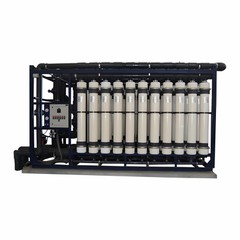

The Micro-Bubble DAF Clarification Unit separates total suspended solids (TSS), fats, oils, and grease (FOG), colloidal particles, and low-density contaminants from industrial wastewater. Dissolved Air Flotation (DAF) is engineered for streams where standard gravity sedimentation fails due to low particle density, high FOG concentration, or poor settling characteristics.
Key Treatment Functions
Primary Wastewater Clarification: Rapid removal of free-floating contaminants.
FOG & Hydrocarbon Separation: High-efficiency recovery of fats, oils, and greases.
Colloidal Particle Removal: Aggregation and flotation following chemical conditioning.
Pretreatment Protection: Reduces solids loading upstream of biological systems, filtration units, and reverse osmosis (RO) membranes.
How the Micro-Bubble DAF Process Works
Chemical Conditioning: Coagulants and polymers are injected into incoming wastewater under rapid mixing followed by low-shear flocculation, forming larger flocs.
Dissolved Air Generation: A side stream of clarified effluent (10% to 30%) is pressurized to 0.4–0.6 MPa and saturated with air. Passing through a release nozzle generates micro-bubbles (10 to 30 microns).
Bubble-Particle Attachment: Micro-bubbles attach to flocs and oil droplets within the contact zone, lowering particle density and driving them to the surface.
Mechanical Surface Skimming: A continuous skimmer moves the concentrated sludge blanket into the discharge hopper while clarified water exits via bottom underflow baffles.
Process Performance: DAF vs. Conventional Sedimentation
|
Consideration |
Micro-Bubble DAF System |
Conventional Sedimentation |
|
Separation Mechanism |
Dissolved air micro-bubble flotation |
Gravity settling |
|
Low-Density & Floating Solids |
High efficiency |
Low efficiency |
|
Fats, Oils & Grease (FOG) |
Excellent separation (>95%) |
Scum accumulation risks |
|
Footprint Requirements |
Compact (5 to 15 m³/m²·h surface loading) |
Large (1 to 2 m³/m²·h settling rate) |
|
Sludge Dry Solids Content |
High (3% to 6% dry solids) |
Low (1% to 2% wet sludge) |
Technical Specifications Matrix
|
Design Parameter |
Specification Options |
|
Flow Capacity |
5 m³/h to 500+ m³/h per unit |
|
Surface Hydraulic Loading Rate |
5 to 15 m³/(m²·h) |
|
Recycle Ratio |
15% to 30% (variable speed adjustment) |
|
Operating Saturation Pressure |
0.4 to 0.6 MPa |
|
Structural Tank Materials |
Carbon Steel with Heavy Epoxy / SS304 / SS316L / Duplex SS |
|
Skimmer Configuration |
Chain-flight scraper or rotating bridge scraper |
|
Control System |
Local Control Panel or Integrated PLC (Siemens/Schneider) with HMI |
Industrial Applications
Food & Beverage Processing: Meat and poultry processing, dairy, vegetable oil refining, seafood processing.
Industrial Manufacturing: Petrochemical refineries, textile dyeing, pulp and paper mill effluent.
Pretreatment Systems: TSS and FOG load reduction upstream of MBR and MBBR biological systems.
Proven Project Case Studies
|
Parameter |
Case Study 1: Poultry Processing |
Case Study 2: Petrochemical Refinery |
|
Location |
Southeast Asia |
Middle East |
|
Influent Flow |
150 m³/h continuous |
300 m³/h peak |
|
Influent Profile |
TSS: 1,800 mg/L | FOG: 950 mg/L |
Hydrocarbons: 650 mg/L | TSS: 450 mg/L |
|
Target Objective |
Protect aeration basin & avoid surcharges |
Pretreatment prior to sand filtration & RO |
|
System Design |
SS304 DAF with flash mixer & flocculator |
Epoxy-coated Carbon Steel DAF with ATEX controls |
|
Performance Results |
Effluent TSS: <80 mg/L (95.5% removal) Effluent FOG: <25 mg/L (97.3% removal) |
Hydrocarbon Removal: >96% Membrane cleaning interval extended 3x |
Quality Control & Manufacturing Standards
Tank Fabrication: Material verification, laser cutting, automated submerged arc welding, non-destructive testing (NDT) on critical welds.
Surface Treatment: Blast cleaning to ISO 8501-1 Sa 2.5 standard followed by high-build epoxy lining (>300 microns dry film thickness).
Factory Acceptance Testing (FAT): Mechanical alignment checks, hydro-testing for structural integrity, bubble density, and air dissolution testing prior to dispatch.
B2B Procurement & Engineering RFQ Checklist
Provide the following parameters to receive a customized sizing proposal:
Hydraulic Profile: Average flow (m³/h), peak flow (m³/h), daily operating schedule.
Wastewater Characteristics: Inlet concentrations of TSS (mg/L), FOG (mg/L), COD (mg/L), pH, operating temperature.
Effluent Targets: Required discharge parameters or downstream protection limits.
Site Constraints: Footprint limits, indoor vs. outdoor setup, electrical supply specifications (voltage/frequency).
FAQ
Q: How do I determine if DAF is preferred over standard gravity clarification?
A: DAF is the optimal choice when dealing with light suspended solids, free or emulsified fats, oils, and greases (FOG), or slow-settling flocs. Unlike gravity clarification, which relies on particle mass, DAF uses micro-bubbles to float low-density particles rapidly, reducing equipment footprint by up to 60%.
Q: Is chemical dosing always required for DAF operation?
A: Not always, but it is recommended for colloidal particles and emulsified oils. Coagulants (e.g., PAC or Ferric Chloride) neutralize particle charges, while polymers (flocculants) bind particles into micro-flocs. Benchtop jar testing is recommended to confirm exact chemical requirements.
Q: What is the typical micro-bubble size, and why does it matter?
A: Our systems produce micro-bubbles sized between 10 and 30 microns. Micro-bubbles provide a higher surface-area-to-volume ratio, ensuring optimal attachment to flocs without shearing them apart during flotation.
Q: Can the DAF unit handle fluctuating flow rates and solids loadings?
A: Yes. DAF systems accommodate flow variations using variable frequency drives (VFDs) on recycle pumps and adjustable scraper speed controls. For severe flow or concentration surges, upstream flow equalization is recommended.
Q: What routine maintenance is required for a DAF system?
A: Routine maintenance includes inspecting surface scraper flights and chains, monitoring saturation tank pressure, checking recycle pump mechanical seals, and periodically clearing pressure-release nozzles to ensure consistent bubble generation.
Hot Tags: micro-bubble daf clarification unit, China micro-bubble daf clarification unit manufacturers, suppliers, factory, Skid-Mounted Heavy-Duty Effluent Plant


