What Is Dissolved Air Flotation (DAF)?
Removing oil, grease, and suspended solids from wastewater is one of the biggest challenges in industrial water treatment.
Many contaminants are too light to settle naturally but too small to be removed efficiently by simple screening. In these situations, Dissolved Air Flotation (DAF) offers an effective solution.
Instead of relying on gravity to make particles sink, a DAF system uses millions of microscopic air bubbles to lift contaminants to the water surface, where they are removed mechanically. Because of this unique separation method, DAF has become one of the most widely used pretreatment technologies for industrial wastewater.
Why Gravity Alone Is Often Not Enough
Traditional sedimentation tanks depend on gravity.
Heavy particles settle to the bottom over time, but many wastewater streams contain pollutants that behave differently, including:
Oils and grease
Fine suspended solids
Algae
Organic particles
Low-density sludge
These contaminants either float naturally or remain suspended in water, making gravity separation slow and inefficient.
This is where dissolved air flotation provides a significant advantage.

How Does a DAF System Work?
Although different manufacturers may use different layouts, the operating principle is essentially the same.
Step 1 - Air Is Dissolved Under Pressure
A portion of treated water is pumped into a pressure vessel where compressed air is dissolved into the water.
Because the water is under pressure, much more air can dissolve than under normal atmospheric conditions.
Step 2 - Pressure Is Released
When this pressurized water enters the flotation tank, the pressure drops rapidly.
The dissolved air immediately forms millions of microbubbles, typically between 30 and 80 microns in diameter.
These bubbles are extremely small, allowing them to contact fine suspended particles efficiently.
Step 3 - Bubbles Attach to Pollutants
As the bubbles rise, they attach themselves to suspended solids, oil droplets, grease, and other light contaminants.
This greatly reduces the overall density of the particles, allowing materials that would otherwise remain suspended to float to the surface.
This process is the key reason DAF achieves much higher removal efficiency than simple gravity separation.
Step 4 - Floating Sludge Is Removed
A surface skimmer continuously removes the floating sludge into a sludge collection tank.
Meanwhile, clarified water exits from the bottom or outlet side of the system for further treatment or discharge.
Why Microbubbles Matter
The effectiveness of a DAF system depends largely on bubble quality rather than simply producing more air.
Microbubbles offer several important advantages:
Larger total surface area
Better contact with suspended particles
Higher attachment efficiency
Faster flotation speed
Improved removal of fine contaminants
This is why pressure, recycle ratio, saturation efficiency, and release technology all play important roles in DAF performance.
What Can a DAF System Remove?
A properly designed DAF system is commonly used to remove:
Oil and grease
Suspended solids (SS)
Algae
Animal fats
Food processing residues
Fibers
Paint particles
Fine sludge
Organic suspended matter
In many industrial applications, removal efficiencies of suspended solids and oil can exceed 90%, depending on wastewater characteristics and chemical dosing conditions.

Common Industrial Applications
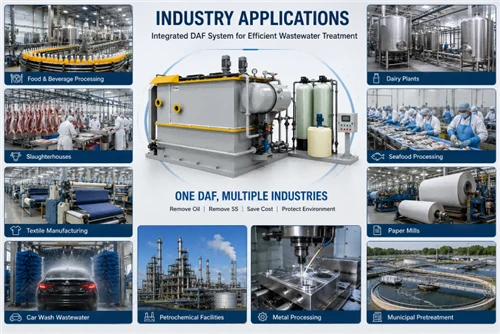
DAF systems are widely used across many industries, including:
1.Food and beverage processing 2.Slaughterhouses
3.Dairy plants 4.Seafood processing 5.Textile manufacturing
6.Paper mills 7.Petrochemical facilities 8.Metal processing
9.Car wash wastewater 10.Municipal pretreatment
In many projects, DAF serves as the first major treatment step before biological treatment, ultrafiltration (UF), or reverse osmosis (RO).
What Determines DAF Performance?
Not all DAF systems deliver the same results.
Several engineering factors influence flotation efficiency, including:
Air saturation efficiency
Bubble size distribution
Hydraulic retention time
Surface loading rate
Chemical dosing (PAC/PAM)
Skimmer design
Equipment material and corrosion resistance
Selecting the right combination depends on the characteristics of the wastewater rather than simply choosing the largest machine.
Choosing the Right DAF System
Every wastewater project is different.
Oil concentration, suspended solids, wastewater flow rate, and available installation space all affect equipment selection.
A well-designed DAF system should balance treatment efficiency, operating stability, maintenance requirements, and long-term operating costs.
Rather than focusing only on equipment size, it is more important to ensure that the flotation process is properly matched to the wastewater characteristics.

Conclusion
Dissolved Air Flotation has become one of the most effective technologies for removing oil, grease, and suspended solids from industrial wastewater.
By using microscopic air bubbles instead of gravity alone, DAF systems achieve rapid solid-liquid separation while reducing the load on downstream treatment processes.
For industries seeking reliable pretreatment with stable performance, DAF remains one of the most practical and widely adopted solutions.