AO (Anaerobic-Aerobic) Process
Working Principle: This is a classic process. It mainly consists of two stages:
Stage A - Anaerobic Stage: In an oxygen-free environment, anaerobic microorganisms decompose large organic molecules in wastewater into smaller molecules, releasing phosphorus.
Stage O - Aerobic Stage: Under oxygenated conditions, aerobic microorganisms proliferate, forming activated sludge. They consume organic pollutants in the wastewater (including small organic molecules and ammonia nitrogen from the anaerobic stage), converting them into carbon dioxide, water, and their own sludge. Simultaneously, they also absorb phosphorus.
A2O (Anaerobic-Anoxic-Aerobic) Process
Working Principle: This can be seen as an upgraded version of the AO process, adding an anoxic stage between the anaerobic and aerobic sections.
Anaerobic Stage: Releases phosphorus.
Anoxic Stage: Utilizes nitrate nitrogen (NO₃⁻) from the mixed liquor returned from the aerobic stage. Under the action of denitrifying bacteria, it is reduced to nitrogen gas (N₂) and discharged, achieving nitrogen removal.
Aerobic Stage: Removes organic matter, nitrifies (converts ammonia nitrogen NH₄⁺ to nitrate nitrogen NO₃⁻), and absorbs phosphorus.
MBR (Membrane Bioreactor) Process
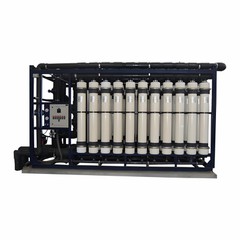
Working Principle: This is a representative of "high technology." It combines biological treatment (activated sludge process) with membrane separation technology. The traditional secondary sedimentation tank is completely replaced by an ultrafiltration membrane module (MBR membrane).
Wastewater undergoes biochemical reactions in the bioreactor.
Then, solid-liquid separation occurs through the MBR membrane (with pores thousands of times finer than a human hair). Water and tiny molecules can pass through, while bacteria, viruses, and suspended solids are completely retained.
MBBR (Moving Bed Biofilm Reactor) Process
Working Principle: This is an ingenious new process. It involves adding a large amount of suspended biological media (typically porous polyethylene or polyurethane spheres) with a specific gravity close to water to an aerobic tank. These media provide a huge surface area for microbial growth, forming a "moving biofilm." Under aeration, the media flows in the water, making full contact with the wastewater, thereby effectively degrading pollutants.
Core Advantages:
High treatment load and strong shock resistance: Large biomass and good system stability.
Non-clogging and no backwashing required: The flow of the media avoids clogging problems.
High flexibility: Can be used as an upgrade technology for existing wastewater treatment facilities.
SBR (Sequencing Batch Reactor) Process
Working Principle: It is not a continuous flow process, but a cyclical process in which processes occur in batches according to a time sequence within the same reactor. A typical cycle includes: Influent → Reaction (Aeration) → Sedimentation → Drainage → Idle.
All processes are completed in a single SBR tank, operated sequentially through automated control.
Core Advantages:
Simple process, small footprint: Eliminates the need for sedimentation tanks and sludge return systems.
Flexible operation: Nitrogen and phosphorus removal can be easily achieved by adjusting the time of each stage.
Excellent sedimentation effect: Ideal static sedimentation conditions result in high-quality effluent.