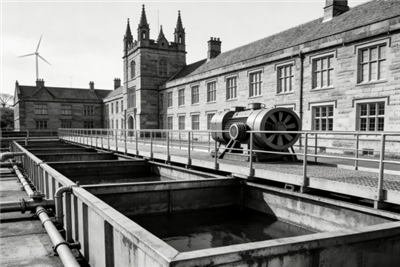
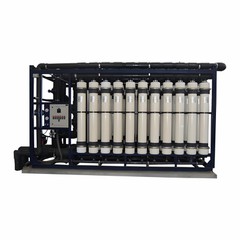
The first packaged sewage treatment plant in history was the Oxigest activated sludge sewage treatment equipment, which was installed in Scotland in 1961 to treat domestic sewage from a school. This sewage treatment plant was designed to be open-topped, with a walkway on the top of the tank where control panels and air blowers were installed. Under the walkway, there was an air manifold, and two aeration sedimentation tanks were provided. Aerators were suspended at the bottom of the first sedimentation tank. It greatly improved the sewage treatment efficiency of this school, and since then, people have discovered the development potential of packaged sewage treatment plants!
The first packaged sewage treatment plant adopted the RBC (Rotating Biological Contactor) system. Later, packaged sewage treatment plants based on filter media emerged. In the 1970s and 1980s, the concept of Biological Aerated Filter (BAF) matured in Europe, laying the foundation for integrated filter media treatment.

In the 1990s, integrated MBBR (Moving Bed Biofilm Reactor) technology was extensively researched and widely promoted for use.
In the early 21st century, with the global environmental protection demand for sustainable development, and in response to the growing rural and township sewage situation, mature box-type integrated equipment integrating filtration, anaerobic, and aerobic functions was optimized. During this period, Lingke Environmental Protection kept up with the trend of environmental protection development, striving from producing the first set of packaged sewage treatment equipment to manufacturing the 100,000th set.
Great progress has been made in the design and manufacture of packaged sewage treatment plants over these decades. At present, most equipment is made of Polypropylene (PP) or Glass Reinforced Plastic (GRP). Most systems are also installed underground, with minimal impact on the surrounding environment. Moreover, they are convenient and quick to install, and the product is now very mature.